
Literacy for the Children of India’s Slums and Inner Cities
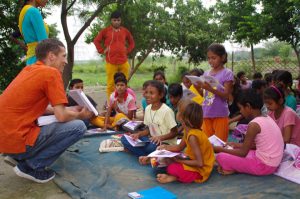
Children study English using the Ollie the Elephant books, at one of the slums in India where Charity United’s educational programs are in operation.
Can you imagine what your life would be like now if you had grown up without any access to education?
It may seem so unreal that it’s difficult to imagine. But if you take a moment, you can gradually begin to picture it.
For millions of children around the world, this is the stark reality. And these children can do nothing about their situation unless we step in to help.
One of Charity United’s projects has focused on bringing education to underprivileged children in India’s slums, in partnership with local volunteers and tutors on the ground. We built and piloted a literacy program, trained tutors, and provided teaching materials directly in the communities we serve. Now, we’re working to expand and strengthen that foundation — with the infrastructure, staffing, and resources needed to bring the program to more children.
Funds raised support this work in whatever form it’s needed most: books, workbooks, and school supplies; classroom space and infrastructure; training and support for tutors; and, as we grow, the staff needed to manage the program’s expansion. Needs on the ground shift — a damaged classroom, a new group of tutors, updated materials. Project funds go where they are needed most to keep the program moving forward.
Funds may also be used to provide food and essential survival needs for children and their families, concurrent to giving them the basic educations necessary, to provide them with a route out of poverty.
The images you see on this page were taken in some of the slums where our educational programs have been implemented.
Charity United was founded to make the human rights of the child a reality. Its educational programs are aligned with the Convention on the Rights of a Child adopted by the General Assembly of the United Nations in 1989.
While Charity United grants attention to every right of the child, it pays particular attention to the right of the child to education, as covered in articles 28 & 29 of the Convention.
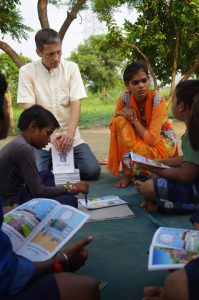
William Tucker, President of Charity United, works with a local tutor to educate children in a slum in India.
Roughly one billion people in the world live in slums. Most of these are children.
Charity United’s slum and underprivileged projects are primarily focused on education. Education is the route out of the slums and opens the door to a future. While governments make every effort to provide high-quality education to all children, this is a daunting and often overwhelming task. Charity United recognizes the responsibility of citizens in making human rights a reality, and seeks to lend support to this effort.
Through surveys of slums around the world, Charity United has identified key areas of need, in line with Articles 28 and 29 of the Convention — with particular focus on Article 28, section 3: raising literacy levels as the foundation for further education.
Charity United’s literacy program brings equal opportunity to girls and boys who cannot afford high-quality education in existing schools.
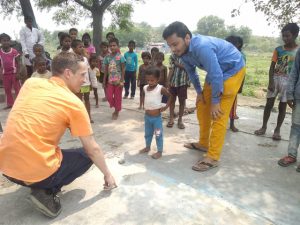
Sometimes, learning starts with drawing in the sand
How our program works
Our program works in several steps, and is designed while keeping the organic learning system of the child in mind. It has been specifically developed to be both cost-effective and easily executable in any situation.
It consists of several phases:
- Phase 1 teaches the child or student spoken English
- Phase 2 teaches the alphabet and learning to read
- Phase 3 teaches writing
- Phase 4 teaches how to use correct grammar
This sequence is never violated or mixed.
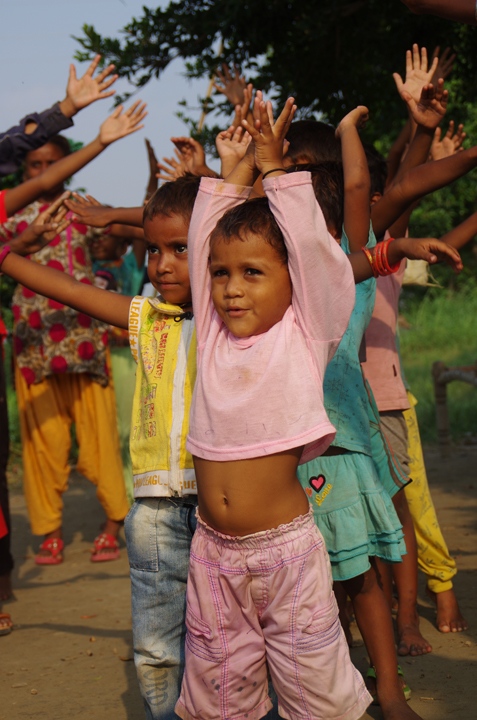
Children learning English verbs through mimicry exercises
Each step is completed fully, before moving on to the next. This follows the natural sequence of learning for any child. A newborn is not taught grammar, or to write. He learns the words for basic objects first, then action words (verbs that describe action) are introduced, then he learns to read, this is followed by writing, and finally, he learns grammar. This is the natural way we learn to speak. This is how language is taught quickly, easily, and perfectly.
Program Details
For a full description of the program, please click here.
How You Can Help
With proper education, we are making the rights of the child a reality and working together to create a better world and an end to poverty. With your help, we can make it. The more support we receive, the more children we can help.